Laser Tattoo Removal
Laser tattoo removal breaks ink into fragments small enough for your immune system to carry away. We use Q-switched Nd:YAG lasers — the MedLite and RevLite platforms — which work at 1064 nm and 532 nm. Most tattoos take multiple sessions spaced six to eight weeks apart. Pricing starts at $500 per session at Naficy Rejuvenation Center in Bellevue, Washington, with a $100 surcharge for coloured tattoos.
How does laser tattoo removal work?
Tattoo ink sits in the dermis in particles too large for your immune system to remove — which is why tattoos are permanent.
A Q-switched laser fires extremely short, high-energy pulses. The ink absorbs that energy far faster than it can dissipate it, and the particles shatter into much smaller fragments. Your body's macrophages then carry those fragments away through the lymphatic system over the following weeks.
Two consequences follow, and both matter for expectations:
- Removal is gradual. Each session shatters a portion of the ink, and clearance happens between sessions as your body does the work — not during the treatment.
- Your immune system does the removing. Which is why spacing between sessions matters, and why results vary between people treated identically.
What lasers do you use?
We use Q-switched Nd:YAG lasers — both the MedLite and RevLite platforms. These deliver two wavelengths:
- 1064 nm — absorbed strongly by black, dark blue and dark grey ink. This is the workhorse wavelength, and it is also the safest wavelength for darker skin because it is absorbed less by melanin.
- 532 nm — absorbed by red, orange and some purple ink.

Which tattoo colours respond well, and which do not
Ink colour is the single biggest predictor of how well a tattoo will clear, and this is where most practices are vague. Being direct about it is more useful.
| Ink colour | Response with Nd:YAG |
|---|---|
| Black, dark blue, dark grey | Excellent — 1064 nm is absorbed strongly. Most amateur and older tattoos are predominantly black and clear well. |
| Red, orange | Good — treated with 532 nm. |
| Purple | Variable |
| Green | Poor — green absorbs best at around 694–755 nm, wavelengths a Nd:YAG platform does not produce. Green ink often persists. |
| Light blue, turquoise | Poor, for the same reason as green. |
| Yellow | Poor — difficult with any laser. |
| White, flesh tones | Poor, and these can darken on treatment rather than fade. |
What this means for you: if your tattoo is predominantly black or dark blue, this is a good treatment and you can expect substantial clearance. If it contains significant green, turquoise or yellow, expect those elements to persist, and we will tell you so before you start rather than after several paid sessions.
We would rather set that expectation honestly than have you discover it at session four.
How many sessions will I need?
There is no reliable single answer, and any practice quoting a firm number without seeing the tattoo is guessing. The factors that determine it:
- Ink colour — as above, the biggest single factor
- Amateur vs. professional — amateur tattoos use less ink, deposited unevenly and more superficially, and typically clear in fewer sessions. Professional tattoos are dense and deep.
- Age of the tattoo — older tattoos have already partially faded and clear more readily
- Location — tattoos closer to the heart, with better circulation and lymphatic drainage, clear faster. Those on the hands, feet and lower legs clear slowest.
- Ink density and layering — cover-ups contain more ink than they appear to and take considerably longer
- Your own immune function, general health, and whether you smoke — smoking measurably reduces clearance rates
Sessions are spaced six to eight weeks apart. That interval is not administrative — it is the time your immune system needs to clear the fragmented ink. Treating sooner does not speed removal and increases the risk of skin injury.
How much does laser tattoo removal cost?
| Tattoo size | Per session |
|---|---|
| Small | $500 |
| Medium | $750 |
| Large | $1,000 |
| Very large | Custom quote |
| Colour surcharge | +$100 per session |
Package discounts: 10% off a package of three sessions, 15% off a package of six. Since removal almost always takes several sessions, package pricing is what most patients use. Packages expire three years from purchase.
Pricing depends on size, location, colours, intricacy and session length. Consultation is complimentary, and you will be given an estimate of the number of sessions likely to be required along with the price per session — before you commit to anything.
Full non-surgical pricing · Financing
Does it hurt?
Yes, more than getting the tattoo did, though each pulse is brief. Patients commonly describe it as a hot elastic band snapping against the skin, or spattering grease.
Sessions are short — often only a few minutes for a small tattoo. Topical numbing and cooling are used, and a session is over quickly.
What is the recovery after each session?
| Time after session | What to expect |
|---|---|
| Immediately | The treated area turns white or grey for several minutes — a normal, expected response. Then redness and swelling, like a sunburn. |
| Days 1–3 | Redness, swelling, sometimes blistering or pinpoint bleeding. Keep it clean, covered and moisturised. Do not pick or pop blisters — this is the main cause of scarring. |
| Days 3–14 | Scabbing and peeling as the skin heals. |
| Weeks 2–8 | The fading happens here, as your immune system clears the fragmented ink. This is the phase that actually removes the tattoo. |
| Week 6–8 | Next session, once the skin has fully healed and clearance has plateaued. |
Sun protection between sessions is essential. Treated skin is vulnerable, and tanning the area both raises complication risk and can delay your next session.
What are the risks?
Expected: redness, swelling, temporary whitening, scabbing, and sometimes blistering.
Less common:
- Hypopigmentation — the treated skin healing lighter than surrounding skin. More likely in darker skin, and can be long-lasting.
- Hyperpigmentation — healing darker. Usually temporary.
- Incomplete removal. A realistic possibility, particularly with green, turquoise or yellow ink. Some tattoos fade substantially but never disappear entirely.
- Textural change in the treated skin.
- Paradoxical darkening — white, flesh-toned and some cosmetic tattoo inks can turn dark when treated. A test spot is used where this is a risk.
- Infection, uncommon with proper aftercare.
Scarring: uncommon when the area is cared for properly, and most often the result of picking at scabs or blisters rather than the laser itself.
Who is a good candidate?
- An unwanted tattoo, particularly one that is predominantly black or dark blue
- Realistic expectations about the number of sessions and the possibility of incomplete clearance
- Willing to space sessions six to eight weeks apart and protect the area from sun
- Good general health — your immune system does the clearing
- Not currently pregnant or breastfeeding
Who is not a good candidate?
- You need it gone by a specific date. Removal takes many months, often more than a year.
- You expect complete removal of a multicoloured tattoo. Green, turquoise and yellow frequently persist with any Nd:YAG platform.
- Pregnancy or breastfeeding.
- Active infection or skin condition in the area.
- A history of keloid scarring.
- Recent isotretinoin use.
- A recent tan over the tattoo — postpone until it fades.
- A suspicious lesion or mole within the tattoo. This is assessed before any treatment, never lasered over.
Fading for a cover-up
Not every patient wants complete removal. If your intention is a cover-up, you generally need far fewer sessions — often three to five — because the goal is lightening the existing ink enough for a new design to work over it, rather than clearing it entirely.
Tell us at consultation if that is your plan, since it changes the treatment course and the cost substantially. Bring your tattoo artist's requirements if you have them.
Tattoo removal before and after photos
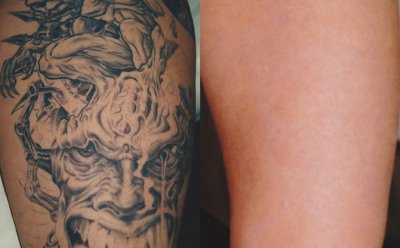
Before and after photographs of laser tattoo removal at Naficy Rejuvenation Center. Individual results vary depending on ink colour, depth, age and location.
Frequently asked questions
How much does laser tattoo removal cost in Seattle?
At our practice, $500 per session for small tattoos, $750 medium, $1,000 large, with a $100 surcharge for colour and custom pricing for very large tattoos. Packages of three and six carry 10% and 15% discounts.
How many sessions does tattoo removal take?
It depends on ink colour, density, age, location and your own immune function, and no honest estimate is possible without seeing the tattoo. You will get an estimate at your complimentary consultation.
How long between tattoo removal sessions?
Six to eight weeks. That is the time your body needs to clear the fragmented ink, and treating sooner does not speed things up.
Does laser tattoo removal hurt?
Yes, typically more than getting the tattoo, though sessions are brief. Topical numbing and cooling are used.
What laser do you use for tattoo removal?
Q-switched Nd:YAG — the MedLite and RevLite platforms — operating at 1064 nm for black and dark ink and 532 nm for red and orange.
Can green tattoo ink be removed?
Green responds poorly to Nd:YAG, because it absorbs best at wavelengths this platform does not produce. Green elements often persist. We will tell you this before you start.
Will my tattoo be completely gone?
Often substantially, sometimes completely — black and dark blue clear best. Complete clearance of multicoloured tattoos cannot be promised.
Does tattoo removal scar?
Uncommon with proper aftercare. The main cause of scarring is picking at scabs or blisters rather than the laser.
Can I remove a tattoo enough for a cover-up?
Yes, and it needs far fewer sessions than complete removal — often three to five. Mention this at consultation, as it changes the plan and cost.
Is tattoo removal safe on darker skin?
The 1064 nm wavelength is the safest option for darker skin because it is absorbed less by melanin. Hypopigmentation risk is still higher, so settings are conservative and a test spot is usual.
Why did my white tattoo ink turn dark?
White, flesh-toned and some cosmetic tattoo inks can undergo paradoxical darkening when treated. This is why a test spot is used where that risk exists.
Can I get a tattoo removed while pregnant?
No.
Next steps
Consultation is complimentary. We will look at the tattoo, tell you honestly how it is likely to respond given its colours, age and location, estimate the number of sessions, and quote the price per session — before you commit to anything.
Naficy Rejuvenation Center is located in Bellevue, Washington, and serves patients from Seattle, the Eastside, and throughout the Pacific Northwest.
Schedule a complimentary consultation · Ask a question
Medically reviewed by Sam Naficy, MD, FACS, board-certified by the American Board of Facial Plastic and Reconstructive Surgery.